


What Are the Benefits of Google Ads for Your Business?
Your potential customer is sitting at their desk right now. They have a problem. They need a solution. They open Google and type exactly what they’re looking for.
Will they find you?
With organic SEO, the answer depends on months of consistent work. With Google Ads, the answer can be yes — starting today.
Google Ads is one of the most powerful advertising platforms ever created. Not because it’s expensive or complicated. Because it puts your business in front of people at the exact moment they’re actively searching for what you offer. No other advertising channel can claim that with the same precision.
In this article, we break down what Google Ads is, how it works, and the specific benefits it delivers for businesses of every size — clearly, honestly, and practically.
What Is Google Ads?
Google Ads — formerly known as Google AdWords — is Google’s online advertising platform. It allows businesses to display ads across Google’s search results, partner websites, YouTube, Gmail, and millions of other placements within the Google ecosystem.
The most widely used format is Search Ads — the text results that appear at the top and bottom of Google’s search results page, marked with a small “Sponsored” label. When someone searches for a keyword relevant to your business, your ad can appear directly above the organic results, capturing attention at the highest-intent moment possible.
Google Ads operates on a pay-per-click — PPC — model. You only pay when someone actually clicks on your ad. You set your budget, define your target audience, write your ad, and Google handles the rest — showing your ad to relevant searchers and charging you only for the clicks you receive.
The Core Benefits of Google Ads for Your Business
Immediate Visibility and Results
SEO is a long-term investment that builds organic visibility over months and years. Google Ads delivers results from day one.
The moment your campaign goes live, your ads begin appearing in front of people searching for your keywords. There’s no waiting period, no ranking process, no gradual climb through search positions. You set your campaign live on Monday, and on Tuesday you’re visible at the top of Google for your target keywords.
This immediacy makes Google Ads invaluable for businesses in several situations — a new website that hasn’t yet built organic authority, a seasonal promotion that needs immediate exposure, a product launch that can’t wait months for SEO to deliver results, or a business that needs to generate revenue now while building long-term organic presence simultaneously.
Unmatched Targeting Precision
Traditional advertising is built on approximation. You buy a billboard on a busy road and hope the right people see it. You run a television commercial during a popular program and hope your audience is watching. You pay for broad exposure and accept that most of it will be wasted.
Google Ads is built on precision. Every targeting decision is intentional, measurable, and adjustable.
Keyword targeting lets you show your ads only when people search for specific terms directly related to your business. Someone searching “emergency plumber in Baku” is not browsing — they have an urgent, specific need. Your plumbing business ad appearing at that moment is not an interruption. It’s a solution.
Geographic targeting lets you show ads only to people in specific locations — a country, a city, a specific radius around your business. A local bakery can target only the neighborhoods within delivery distance. A national brand can run different campaigns in different cities with different messaging and budgets.
Device targeting lets you adjust bids and ad formats based on whether someone is on a desktop, tablet, or mobile phone. A business that converts significantly better from mobile calls than desktop form submissions can increase mobile bids and use call-focused ad formats to maximize phone inquiries.
Demographic targeting lets you layer audience characteristics — age, gender, household income — on top of keyword targeting to refine who sees your ads and how much you’re willing to pay to reach them.
Schedule targeting lets you show ads only during the hours and days when your business is open, when your customers are most likely to convert, or when historical data shows your ads perform best. A restaurant can focus budget on lunchtime and dinner searches. A B2B company can concentrate spend during business hours when decision-makers are at their desks.
You Only Pay When Someone Clicks
One of the most misunderstood aspects of Google Ads is the pricing model. Unlike traditional advertising where you pay for exposure — whether or not anyone engages — Google Ads charges you only when someone actually clicks on your ad.
This pay-per-click model has a profound implication: every dollar you spend represents a real person who saw your ad, found it relevant enough to click, and visited your website. You’re not paying for impressions that go unnoticed. You’re paying for actual engagement.
Combined with precise targeting, this means your advertising budget is spent almost exclusively on people with demonstrated interest in what you offer. The efficiency of this model is fundamentally superior to almost any traditional advertising format.
Complete Budget Control
Google Ads gives you total control over how much you spend, with no minimum budget requirement and no long-term commitment.
You set a daily budget for each campaign — Google will not exceed it. You can start with as little as five dollars per day and scale up as you see results. You can pause campaigns instantly if something isn’t working, or increase budgets immediately when a campaign is performing well.
This flexibility is particularly valuable for small businesses that need to manage cash flow carefully. You’re never locked into a contract. You’re never surprised by a bill you didn’t anticipate. You have complete, real-time control over your spending.
For larger businesses, this control allows sophisticated budget allocation — concentrating spend on the highest-performing campaigns, seasonal promotions, or specific product lines where the return on investment justifies higher investment.
Highly Measurable Return on Investment
If you’ve ever placed an advertisement in a newspaper, on a billboard, or on the radio, you know the frustration of not being able to measure results accurately. You spend the money, you run the ad, and you hope for the best. Attributing specific sales or inquiries to specific ads is nearly impossible.
Google Ads is the opposite. Every aspect of your campaign performance is tracked and measured with extraordinary precision.
You can see exactly how many times your ad was shown — impressions. You can see how many people clicked — click-through rate. You can see what those clicks cost — cost per click. And most importantly, with proper conversion tracking in place, you can see exactly how many of those clicks resulted in a purchase, a form submission, a phone call, or any other action that matters to your business — and what each of those conversions cost you.
This level of measurement transforms advertising from an act of faith into a data-driven business decision. When you know that every hundred dollars spent on a particular campaign generates a certain number of customers with a certain average value, you can make rational decisions about how much to invest and where to invest it.
Reaching Customers at Every Stage of the Buying Journey
Google Ads is not limited to capturing people who are ready to buy right now. The platform’s diverse ad formats and network reach allow you to connect with potential customers at every stage of their decision-making process.
Someone who searches “what is cloud accounting software” is early in their journey — researching, comparing, not yet ready to buy. A Display ad showing your accounting software across the websites they visit keeps your brand visible as they research. A remarketing ad reminding them of your product after they’ve visited your website brings them back when they’re ready to decide.
Someone who searches “buy cloud accounting software for small business” is ready to act. A Search ad that appears at the top of those results and takes them directly to a relevant landing page can convert that high-intent search into a customer immediately.
The ability to reach people at awareness, consideration, and decision stages — with different messaging, different formats, and different bidding strategies — gives Google Ads a comprehensiveness that few other advertising channels can match.
Remarketing: Recapturing Lost Opportunities
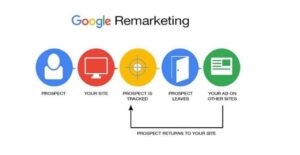
The average website converts between 1-4% of first-time visitors. This means that 96-99% of people who visit your website leave without taking any action.
These are not random strangers. They were interested enough to click on your ad or find your website. They explored your content or your products. They left for any number of reasons — distraction, indecision, price comparison, a phone call that interrupted them.
Google Ads remarketing lets you serve targeted ads specifically to these previous visitors as they browse other websites, watch YouTube videos, or check their Gmail. A carefully crafted remarketing message — perhaps highlighting a specific product they viewed, offering a limited-time discount, or simply reminding them of your business — can bring a significant portion of these lost visitors back to complete their purchase or inquiry.
Remarketing campaigns consistently achieve some of the highest conversion rates and lowest costs per conversion of any Google Ads strategy, precisely because you’re reaching people who have already demonstrated interest in your specific business.
Outperforming Competitors Immediately
In organic search, outranking a competitor who has invested years in SEO can take months or years of sustained effort. In Google Ads, you can appear above them in search results starting today.
This doesn’t mean Google Ads is simply about outbidding competitors. Google’s Quality Score system rewards ads that are highly relevant to the searches they target, have strong click-through rates, and lead to high-quality landing pages. A smaller business with well-crafted, highly relevant ads can outperform a larger competitor with higher budgets but lower quality scores.
For businesses entering a competitive market, launching a new product, or operating in a niche where organic rankings are dominated by established players, Google Ads creates an immediate competitive opportunity that organic search simply cannot provide in the short term.
Invaluable Business and Market Insights
Beyond the direct benefits of traffic and conversions, Google Ads generates data that is extraordinarily valuable for understanding your market, your customers, and your business.
The Search Terms report shows you the exact words and phrases real people used before clicking on your ads. This is not an approximation or a market research estimate — it’s actual search behavior from your actual potential customers. The language they use, the questions they ask, the specific problems they describe — all of this is visible in your account and directly applicable to your broader marketing, content, and product strategy.
Performance data reveals which value propositions resonate most with your audience. Testing different ad headlines and descriptions shows you which messages drive action and which ones don’t. This insight doesn’t just improve your Google Ads performance — it informs your website copy, your sales conversations, your email marketing, and every other customer-facing communication.
Conversion data reveals which products, services, or offerings generate the most revenue relative to advertising cost. This data helps you make better decisions about where to focus your business development efforts, where to invest in additional inventory or capacity, and which parts of your business have the greatest growth potential.
Scalability on Your Terms
Google Ads scales with your business in a way that very few other channels can match.
When a campaign is performing well — delivering customers at a cost that makes business sense — you can increase the budget and get more of the same results. There’s no negotiating a larger media buy, no waiting for a new publication cycle, no lead time for new creative. You increase your daily budget and your campaign runs harder immediately.
When you need to pull back — slow season, budget constraints, operational capacity limits — you reduce budgets or pause campaigns with the same immediacy. This two-way scalability gives you a level of control over your customer acquisition pace that traditional advertising cannot provide.
Google Ads and SEO: Better Together
A common question businesses ask is whether they should invest in Google Ads or SEO. The most effective answer is both — used strategically and in coordination.
Google Ads delivers immediate visibility while SEO builds long-term organic authority. In the months before SEO begins to generate meaningful traffic, Google Ads can sustain your business with consistent leads and sales.
Once SEO begins to rank you organically for important keywords, you can make more informed Google Ads decisions — concentrating paid spend on highly competitive terms that are difficult to rank for organically, on new keywords you’re testing, or on product and service categories where the commercial intent is highest.
Running both channels also gives you twice the presence on the search results page. Users who see both your paid ad and your organic listing are more likely to trust your business and more likely to click. The combined effect is greater than the sum of its parts.
Common Misconceptions About Google Ads
Several persistent myths prevent businesses from taking advantage of Google Ads effectively.
The belief that Google Ads only works for big budgets is simply not true. While larger budgets allow for broader reach, well-managed campaigns with modest daily budgets can deliver meaningful results for small businesses targeting specific local audiences or niche keywords. The key is intelligent targeting, not total spend.
The belief that Google Ads is too complicated for non-experts has some truth, but overstates the barrier to entry. Google has invested heavily in making the platform more accessible, and for many campaign types, the basics can be learned reasonably quickly. That said, sophisticated campaign management — the kind that consistently achieves excellent results — does benefit significantly from experience and expertise.
The belief that you’re wasting money if not every click converts ignores the nature of the buying process. Not every click results in an immediate purchase. Some clicks generate awareness that leads to a future direct search. Some clicks lead to inquiries that take weeks to close. Measuring Google Ads performance requires understanding the full customer journey, not just immediate conversions.
Is Google Ads Right for Your Business?
Google Ads works for virtually every business category — local services, e-commerce, B2B, professional services, hospitality, healthcare, education, and more. The question is not whether Google Ads can work for your business, but how to deploy it most effectively given your specific goals, market, and budget.
Businesses with a clear understanding of their customer lifetime value, their cost of customer acquisition, and their conversion rates are best positioned to run Google Ads profitably. If you know that a typical customer is worth five hundred dollars to your business over their lifetime, and Google Ads can deliver customers at a cost of one hundred dollars each, the return on investment is clear and compelling.
If you don’t yet have these numbers, starting with Google Ads at a modest scale specifically to gather this data is a reasonable approach. The campaign data will reveal what customers are actually worth and what you can sustainably afford to pay to acquire them.